When the Money Tightens but the Spending Doesn't: Where Value Quietly Leaks
As Q1 closes and performance reviews begin, this may be worth keeping in mind.
There is a conversation that rarely happens at the right moment.
Revenue comes in light. The raise takes longer than expected. The market shifts. Capital tightens.
Everyone knows it.
Few say it plainly.
Instead, the organization continues operating against a plan built for a different reality.
Budgets remain intact. Headcount plans stay assumed. Departmental allocations feel pre-approved.
And somewhere between investor expectation and operator reality, value begins to leak.
Not dramatically. Not all at once. But steadily, in the space between what was planned and what is actually possible.
The First Fracture Is Not Cash. It's Permission.
In constrained periods, the instinct is to label the issue as "underfunding."
But underfunding alone rarely kills momentum.
Misaligned economic permissions do.
If revenue lands at 80 percent of plan, the enterprise has access to 80 percent of its economic engine. The math is straightforward. The organizational response rarely is.
Yet in many companies, spend authority does not automatically adjust.
Operations cut shifts. Production pauses lines. Working capital gets trapped in excess inventory driven by optimistic forecasts.
Meanwhile, another function continues deploying capital against a static annual budget.
Because "it was approved."
That is where cultural strain begins.
Not because one department is wrong.
But because constraint is not shared.
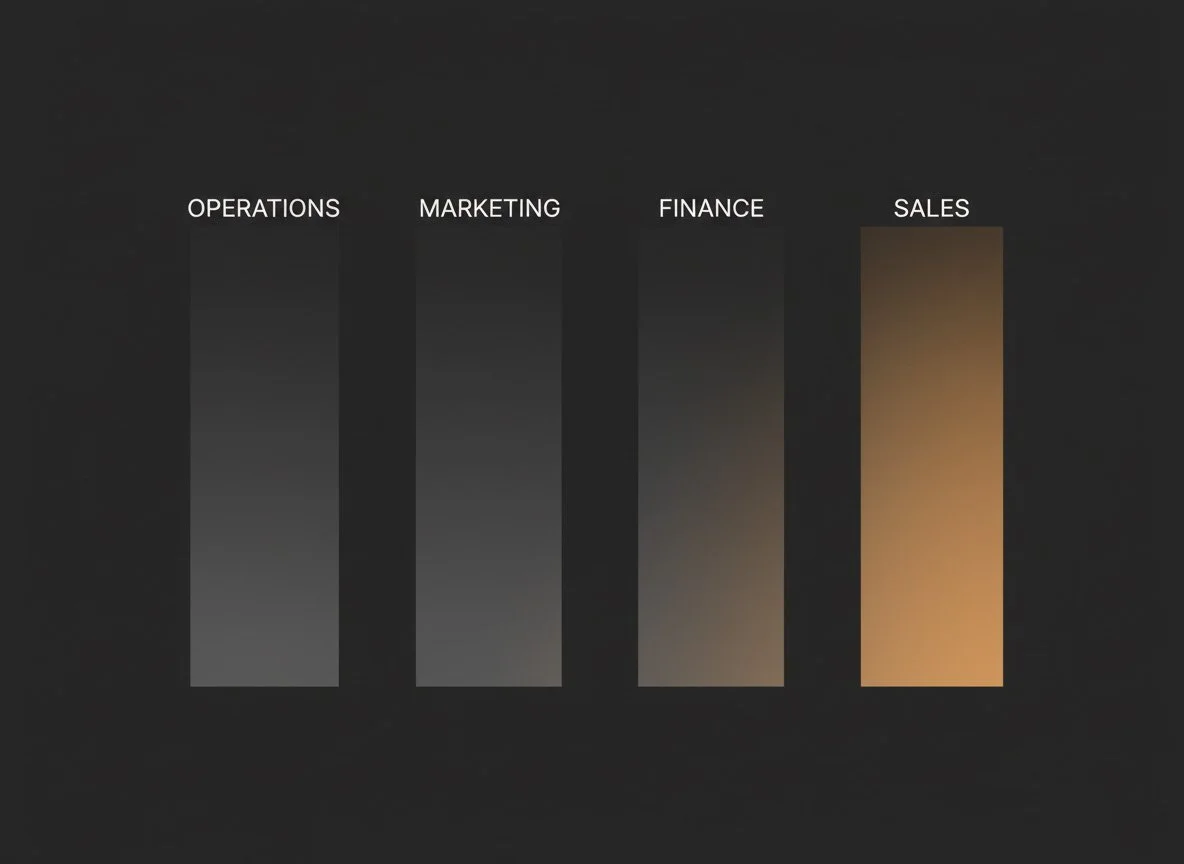
Departments do not fail together when spending permissions are uneven.
The operations team watches their overtime get zeroed while the marketing calendar proceeds unchanged. The plant manager absorbs headcount freezes while the sales team onboards new territory reps. Finance defers system upgrades while a brand refresh moves forward.
Each decision may be defensible in isolation. But the pattern creates fractures.
And once teams begin to perceive that constraint is uneven, trust erodes faster than cash.
The Static Budget Assumption
Most budgets are built on forecasted revenue.
Forecasts are conditional.
Yet once approved, budgets often take on the psychological weight of entitlement.
Operators assume: If the board approved it, it stands unless explicitly revoked.
Investors assume: If performance slips, management will tighten accordingly.
The problem is the absence of explicit renegotiation.
No one recalibrates the economic contract inside the organization.
This is not a failure of intelligence. It is a failure of process.
Annual planning creates a dangerous fiction: that capital availability is fixed for twelve months. In stable markets with predictable demand, that fiction holds. In volatile conditions, it becomes liability.
The plan approved in Q4 assumed a cost of capital that no longer exists. It assumed a customer acquisition cost that has since doubled. It assumed a supply chain that has since fractured. It assumed a competitive landscape that has since shifted.
And yet the spend profile remains anchored to the original model.
So spending in some areas continues as if capital were still abundant, while other areas absorb immediate cuts.
The enterprise fractures along departmental lines.
And the friction that follows is often mislabeled as execution failure.
It is not. It is a governance failure.

Hiring for scale without funding for scale creates preventable burnout.
Hiring Ahead of Infrastructure
The same dynamic holds true for talent strategy.
A company hires a senior executive from a well-capitalized CPG environment.
The resume signals scale. The pedigree signals capability. The compensation reflects the market they came from.
But the infrastructure and capital needed to enable that talent were based on projected funding that has not materialized.
The organization celebrates the hire.
Then quietly clips their wings.
Initiatives stall. Data tools are deferred. Marketing programs are underfunded. Supply chain investments remain hypothetical. The team they were promised becomes a headcount freeze. The budget they were sold becomes a negotiation.
High performers disengage when they cannot perform.
The problem was not the hire.
It was the assumption that projected capital was equivalent to secured capital.
I have seen this pattern play out repeatedly.
An operator joins with a mandate to professionalize operations. The board is enthusiastic. The CEO talks transformation. The offer letter reflects ambition.
Six months later, the ERP implementation is on hold. The production equipment refresh is pushed to next year. The quality team expansion is frozen. The executive is running a change agenda with no capital to fund it.
They begin to disengage. The board wonders why the transformation stalled. The narrative shifts: wrong hire, wrong fit, wrong timing.
But the fit was fine. The timing was fine. The funding was imaginary.
I remember an underfunded head of marketing — a top recruit from a well-capitalized CPG company — telling me: "I've never worked so hard in my life and failed."
She had not failed. She had been set up to fail. The organization hired for the company they hoped to become, then funded for the company they actually were.
When you hire for scale but fund for survival, you do not get transformation. You get talented people burning out against constraints they were never told existed.
The Board's Responsibility During Contraction
Growth phases demand acceleration.
Constrained phases demand clarity.
Boards and investors have a responsibility not only to fund expansion, but to guide recalibration.
That requires more than approving cost reductions.
It requires actively redefining:
What revenue level we are now planning against
What percentage of budget flexes with performance
Which investments remain non-negotiable
Which functions scale down proportionally
What triggers automatic reforecast conversations
Without that explicit guidance, operators are left making uneven cuts in isolation.
And uneven cuts create internal inequity.
Equity of constraint matters.
If the organization is tightening, it must tighten visibly and proportionally.
Otherwise morale declines not because the business is struggling, but because fairness appears absent.
I have watched companies navigate significant contractions both ways — some with culture intact, others with it shattered. The difference was not the severity of the cuts. It was the transparency of the logic.
When leadership says: revenue is at 80 percent, so every function is flexing to 80 percent of discretionary spend, and here is exactly how that applies to each team — the organization can absorb it.
When leadership cuts operations by 25 percent while holding other functions flat, the organization cannot absorb the inequity. Even if the logic is sound, the perception is favoritism. And perception, in constrained periods, determines retention.
The Real Cost of "Keep Going"
One of the most common phrases during delayed raises is simple:
Keep going.
Hold the line.
Push through.
That works while confidence remains high.
But when capital uncertainty stretches beyond a quarter or two, the instruction becomes misaligned with reality.
Teams feel it first.
They see hiring continue while overtime is cut. They watch campaign budgets deploy while production slows. They manage inventory overhang while forecasts remain optimistic in board decks. They hear about strategic investments while their department operates on fumes.
Eventually, the organization loses something more valuable than cash.
It loses shared belief.
Belief that leadership understands operational reality. Belief that sacrifice is distributed fairly. Belief that the plan reflects conditions on the ground.
Once that belief erodes, rebuilding it costs more than the capital that was being conserved.
The best operators leave first. They have options. They recognize dysfunction before it becomes crisis.
The ones who stay become defensive. They protect their teams, their budgets, their headcount. The organization shifts from collaborative to territorial.
And the board, reviewing dashboards and decks, wonders why execution has become so difficult.

Execution improves when capital permissions move with performance.
Dynamic Reforecasting Is a Governance Discipline
Healthy enterprises treat budgets as living instruments.
Revenue shifts. Spend flexes. Headcount adjusts. Priorities reorder.
Not reactively. Deliberately.
That discipline requires communication between investors and operators in real time.
Not after cash becomes tight. Not after morale erodes. Not after talent walks.
At the first signal that forecast and performance have diverged.
This is not about creating chaos or abandoning planning. It is about building a reforecast trigger into governance rhythm.
When revenue falls below 90 percent of plan for two consecutive months, a reforecast conversation is automatic.
When customer acquisition cost exceeds plan by more than 15 percent, spend authority adjusts.
When a major customer delays or churns, the capital allocation committee convenes.
These are not crisis responses. They are governance protocols.
Because bootstrapping itself is not the enemy.
Static thinking during dynamic conditions is.
The Conversation That Does Not Happen
The companies that survive constrained phases are not always the best funded.
They are the most aligned.
Aligned on what capital actually exists. Aligned on what it permits. Aligned on how quickly those permissions change when reality does.
The conversation that does not happen often enough is simple:
If we are operating at 80 percent of plan, are we also spending at 80 percent of plan?
And if not, why not?
If certain investments are protected, what is the explicit rationale?
If certain functions are absorbing disproportionate cuts, what is the explicit rationale?
If the answer is "we haven't discussed it," then the organization is leaking value into the gap between assumption and reality.
That is not a finance question.
It is a governance question.
And where it goes unanswered, value quietly leaves the table.
Closing Observation
Every constrained period eventually ends.
Markets recover. Fundraises close. Revenue returns.
But organizations remember how they were treated during the difficult stretch.
If constraint was shared visibly and fairly, loyalty deepens. Teams emerge more cohesive, more resilient.
If the constraint was absorbed unevenly, resentment lingers. The best talent departs as soon as options return.
The economic outcome of a constrained period is often determined by the capital markets.
The cultural outcome is determined by governance.
Boards and investors who understand that distinction protect more than cash.
They protect the capacity to execute when conditions improve.
And that capacity is where enterprise value actually lives.